
Along with The 39 Steps and Psycho, Spellbound is definitely in Alfred Hitchcock's top 10 films. A great plot revolving around a psychiatric clinic and guilt complex which has been adapted to stage so many times since its release. If you haven't seen the film, and intend to, you should probably stop reading (because I mention possible spoilers). I am less approaching the plotline of the film and more try to pinpoint a moment in the film I feel irrelevant - yes I'm critical. Then I will talk about the viewers ability to co-construct the narrative in a plot.
Now to the only criticism I have when coming to irrelevance, the scene at the start of the film with Mary Carmichael. She is a patient at the clinic and from the instance we are introduced to her we know she is a tough patient (“watch her carefully, don’t take your eyes off her” – nurse). As the scene unfolds, he flirts with “Harry” and then proceeds to present herself as a difficult patient to Dr. Constance Petersen. One other patient’s story is shown to the viewer by Hitchcock, that of Mr Garmes. This is however relevant to the plot because of the guilt complex he has is relevant to that of John Ballantine’s. Another reason he is relevant and “Miss Carmichael” is not, is that he tries to kill another patient and himself – drawing together many different parts of the plot – how dangerous this guilt complex can be, the fainting of J.B in the surgery room, and also the recurring blade/knife motif. Mary Carmicheal, on the other hand, is an irrelevant scene that plays only the purpose of showing that they are in a psychiatric clinic, a scene Hitchcock could have manipulated in a different way.
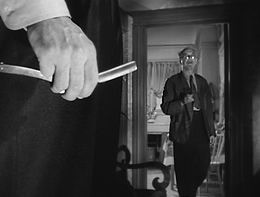
As it says on pg.93 of Film Art, “The plot may arrange cues in ways that withhold information for the sake of curiosity or surprise. Or the plot may supply information in such a way as to create expectations or increase suspense. All these processes constitute narration, the plot’s way of distributing story information in order to achieve special effects.” When the viewer is co-constructing the narrative they are a part of the story’s plot. The scene in the film where I find myself co-constructing the narrative most, due to Hitchcock’s manipulation, is the one with Dr Brulov and J.B’s conversation late at night, coupled with Constance coming down the stairs in the morning. Whilst Dr Brulov lying dead in a chair seems all too predictable for a Hitchcock film, we cannot help but assume Dr Brulov’s ignorance when conversing with J.B at night. The recurring blade motif, with the strong camera angle of the razor in J.B’s hand, contributes to our co-construction of the narrative. What seems like a naïve Dr Brulov offers J.B milk and chats to him quite normally and it is only until the morning when our respect for Dr Brulov changes hugely. Not only did he realize the threatening nature of J.B he drugged him without either him, or us – the viewer, knowing. “Narrative tension is primarily about withholding information” – Ian McEwan, novelist. Hitchcock withholds this wisdom that Brulov has and for this reason, in our minds, we believe that J.B murdered him during the night.

No comments:
Post a Comment